
alone : un/tethred
Cast and Collaborators:
Direction, Concept, Choreography & Performance: Gwendolyn Gussman
Sound Design & Live Musical Performance: Nicholas Caputo
Set Design: Maki Teshima
Lighting Design & Production Management: Alex Taylor
Costume Sourcing: Gwendolyn Gussman
Stage Manager: Emma Kimball
Assistant Director: Bailey Harper
Initial Musical Development & Collaboration at Carroll Hall: Daniel Weidlein
at the line
Visual art installation: Ronny Quevedo’s at the line
Sound Design & Live Musical Performance: Nicholas Caputo
Performers: Krista Brown, Grace Cooper, Gwendolyn Gussman, Bailey Harper, Amy Trapani-Bowen, Cassidy Wagner
Denver Museum of Contemporary Art
It’s been a whirlwind month for Gwendolyn Gussman, the artistic director, choreographer, and founder of HOLDTIGHT. In a single weekend, she premiered the full-length work alone : un/tethered at the Newman Center for Performing Arts. At the Museum of Contemporary Art, she also presented the durational piece at the line. I was fortunate to experience both distinctly unique works on December 7th and 8th.
On Saturday evening, I went to the Byron Theater at the Newman Center to watch alone : un/tethered, which is part of a trilogy of works in the process of being created by Gwendolyn Gussman for HOLDTIGHT. I was invited to “untether” from my phone by coat-checking it in a cute burlap sack as I entered the theater. Surrendering my phone felt like a welcome reprieve and I already felt lighter by the time I found a seat with a “program” on it. These were paper booklets placed strategically far away from each other, with covers that read “how to be alone.” One of the first pages cited the Orson Welles quote “We’re born alone, we live alone, we die alone,” and posed the question “Do you agree? Why or why not?”
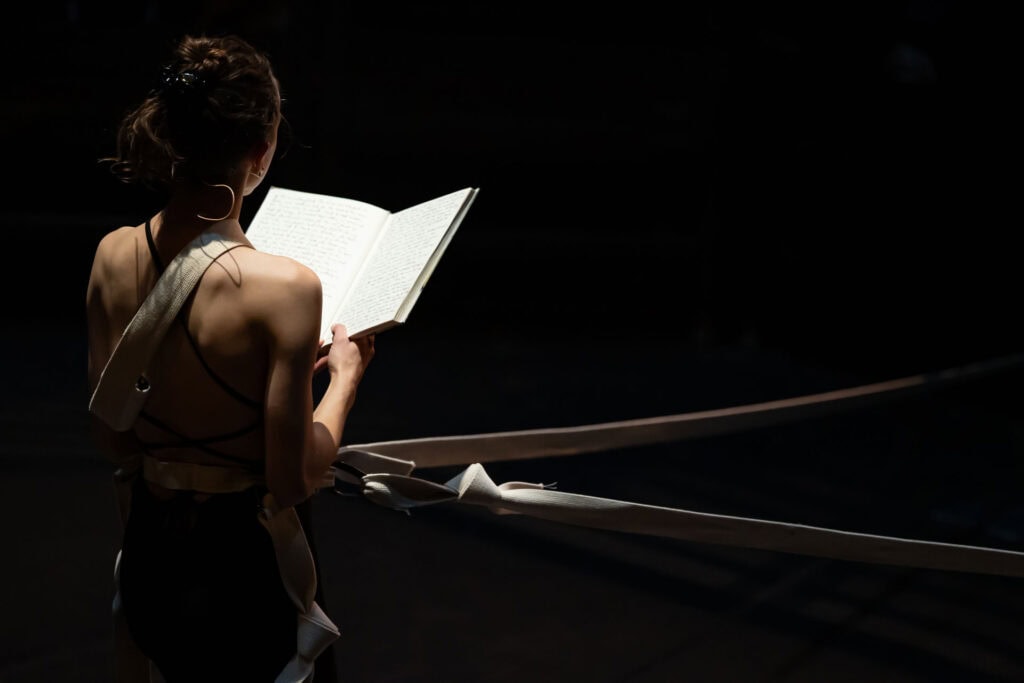
I realized that viewing the work would likely not be a passive experience when I saw the next page, which featured instructions for grounding the body. Looking around the room, I saw people with their eyes closed, squarely rooting their feet into the floor, taking deep breaths. An audience that buys in and follows instructions is a priceless thing, so I closed my eyes too, and listened to the thrumming, meditative tones crafted by sound designer Nicholas Caputo.
The piece opened with Gussman cross-legged on a raised wooden platform, with a loop pedal and a microphone, crooning beautifully looped harmonized tones interspersed with lithe arm movements that seemed to draw the sounds out of the air itself. She descended from the platform and moved in large, sweeping movements that seemed like they erupted from the deepest part of her body and traveled outwards along her limbs. Gussman tumbled through the space in a tangle of limbs, cascading hair, and the billowing fabric of her neutral shift dress. Her mastery of nuanced, textured movement was as impressive as her ability to seamlessly transition into citing facts about willow trees without pausing to catch her breath.
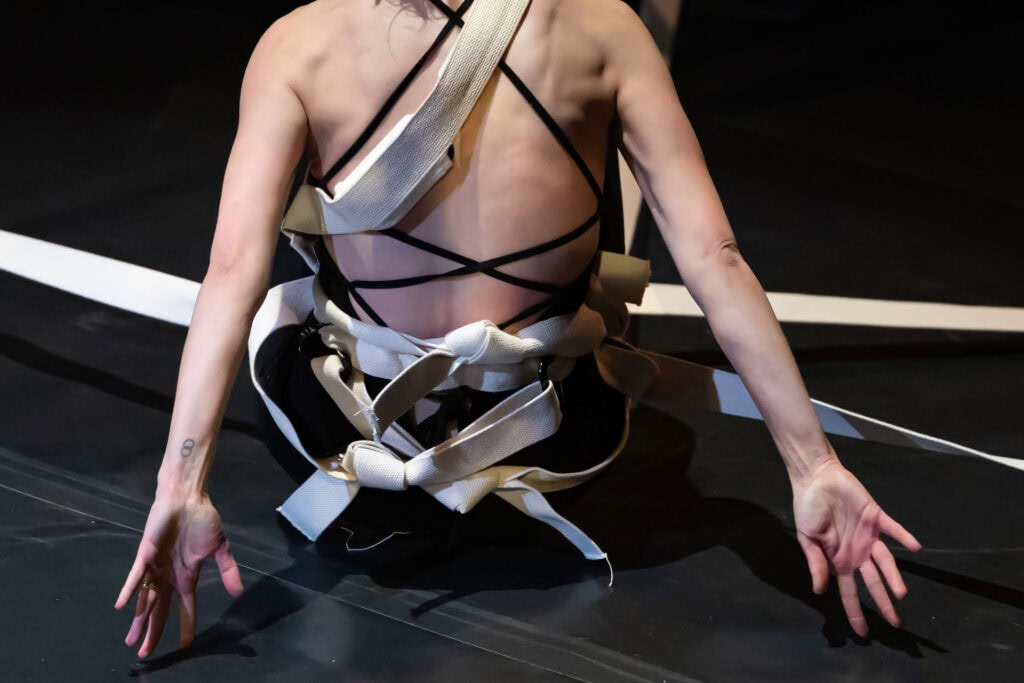
alone : un/tethered reached an emotional climax as Gussman shared a personal story about her birth while literally tethering her body to the theater’s seating structure. Weaving and turning into the straps, she frenzied herself into a nearly impossible tangle, while describing a painful somatic memory of straddling the line of life and death at birth. The four tethers radiating from Gussman resembled umbilical roots, mirroring Maki Teshima’s stunning set design—a sprawling tree of tangled twine, rope, and organic textures.
The piece did not finish here, but actually with Gussman inviting the audience to engage in reflection and participation with some of the themes of the show, namely what being alone really means and how the importance and beauty of alone-ness is highlighted and emphasized by being present in our community. As an impromptu community, we the audience were invited to the stage, where the show ended with similar looping vocals to the start. This recurrence of the opening felt far from redundant; it became transformative, offering a fresh perspective through the shared experience of being onstage with the other audience members. The beautiful lighting by Alex Taylor shone in a myriad of colors, casting a stunning ethereal glow on Gussman as she sang. There’s something so primal about listening reverently in a group with other people, and I found my emotions stirred deeply as the lights slowly dropped to complete the work.
I deeply appreciated how alone : un/tethered avoided pandering to its audience. The HOLDTIGHT collaborative team worked seamlessly to create a production that felt genuine and authentic, inviting viewers to actively engage with the subject matter rather than passively observe. The performance’s raw honesty and innovative storytelling left a lasting impression and I will be looking forward to seeing other parts of the un/tethered trilogy.
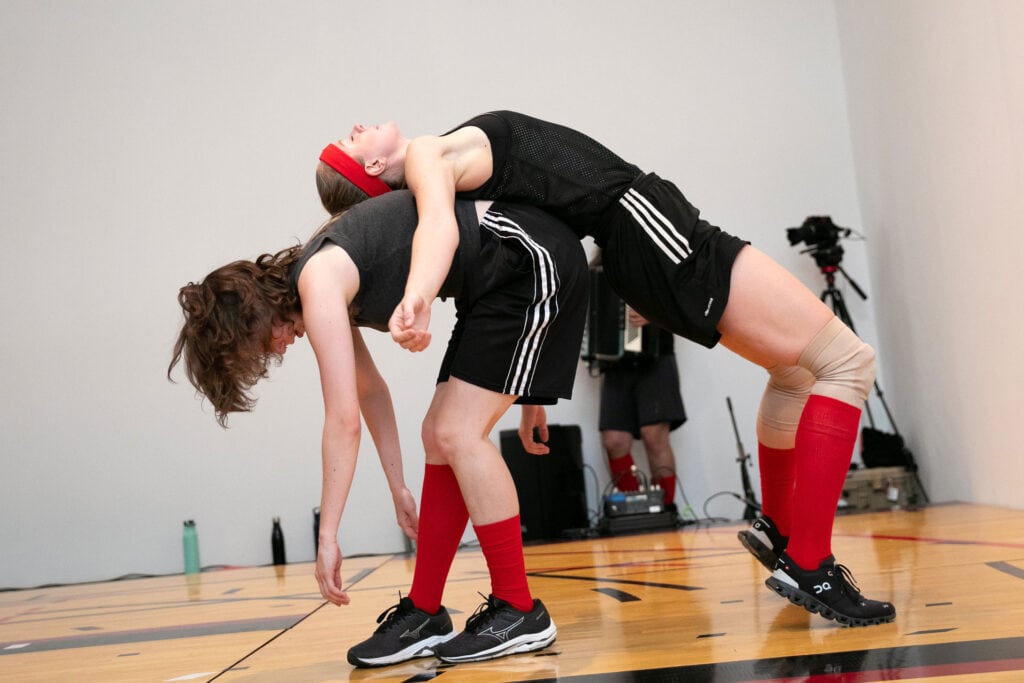
The following day, I went to one of my favorite places in Denver, the wonderfully curated and cool Museum of Contemporary Art, where the exhibition “Movements Towards Freedom” is installed in partnership with Presenting Denver. Here, HOLDTIGHT performed at the line, which was inspired by and occurs on top of a work of the same name by artist Ronny Quevedo. This was described as a “durational performance,” and took place over an hour and a half, with a few (much-needed!) breaks for the dancers. The floor installation by Quevedo was composed of reclaimed wood sourced from a professional basketball court, and hanging above either end were two large hoops made of milk crates turned the wrong way around. Decals adorned the surface of the floor, resembling torn-apart schematic drawings.
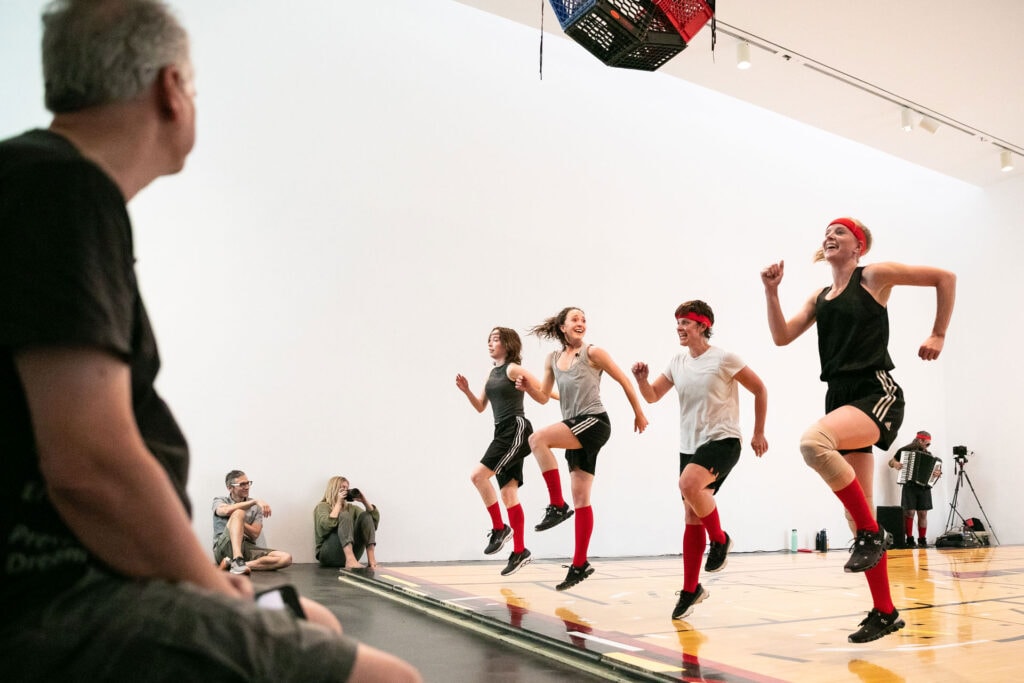
Accompanied by Nicholas Caputo on a metronome and accordion, the six dancers, including Gussman, undertook a series of tasks that varied in both difficulty and athleticism, leaving them bathed in sweat and laughing at themselves by the end.
The joy and hilarity of the tasks–called out on a microphone by Gussman–spread to the audience, and yes, many people stayed for the entirety of the absurd performance. I overheard some audience members say during the breaks “I would like to take a class like that.”
Effort, choice, and failure emerged as central themes in at the line, alongside thought-provoking questions about the nature of athleticism. What defines an athlete? What constitutes a sport? Are dancers athletes? This piece stretched the boundary of “dance,” as it felt like we were watching a performed workout class. It was a delightful experience to watch the structured improvisation unfold, descending into moments of rapturous chaos as the dancers whooped and hollered while hopping on one foot and turning around for a tyranny of minutes. Other times, they snapped into formation, marching back and forth across the court in perfect lines. This echoed the cluttered decals of the installation that were like broken bits of order and rule. The rules of the game were absurd, and I loved every minute of it.
Experiencing both alone: un/tethered and at the line within the same weekend revealed the breadth of Gwendolyn Gussman and HOLDTIGHT’s artistic vision. From the deeply personal and emotive exploration of solitude to the playful and thought-provoking examination of athleticism and absurdity, these works pushed boundaries and invited audience members to reflect, engage, and connect. Both pieces showcased an exceptional collaboration of talent across choreography, design, and performance, leaving a lasting impression of HOLDTIGHT’s innovative approach to contemporary art. As they continue to explore new dimensions of storytelling and movement, I eagerly anticipate what this team will create next.
Breegan Kearney is a Denver-based writer and dance artist. She holds a B.F.A. in Dance Performance from SUNY Purchase and an M.A. in Dance Education from the University of Northern Colorado. Breegan’s writing is informed by her background as a choreographer, performer, and educator.